- What is a mechanical reasoning test?
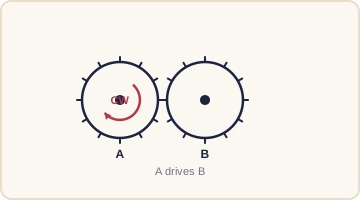
- It assesses your understanding of basic physical and mechanical principles — how gears, levers, pulleys, springs and fluids behave. Each question pairs a short scenario with a diagram, and you choose the outcome the physics predicts. It measures applied understanding, not memorised equations.
- Who uses mechanical reasoning tests?
- They're common in selection for engineering, manufacturing and maintenance roles, the armed forces and emergency services, aviation, and skilled trades and apprenticeships. Publishers like SHL and the Bennett Mechanical Comprehension Test use this format.
- Do I need physics qualifications to do well?
- No. The questions rely on everyday intuition about how machines work plus a few simple rules — for example, a longer lever arm needs less force, and meshed gears turn in opposite directions. No formula sheet or calculator is required.
- How is the test scored?
- You get one mark per correct answer across the four sections — Gears & Pulleys, Levers & Forces, Fluids & Pressure, and Energy & Motion. We email a section-by-section breakdown and your percentile, so you can see how you compare and which area to focus on.
- How can I improve my mechanical reasoning?
- Practise reading diagrams and naming the principle at work in each one, and learn the core rules for levers, gears, pulleys and hydraulics. Reviewing why each answer is right — not just which option — builds the intuition the test rewards.