Twenty-four timed puzzles in the real assessment format — shapes pass through operators that transform them, and you work out the output, the rule or the missing step. We score you and email a section-by-section report with your percentile.
⏱ 25:00
1 / 24
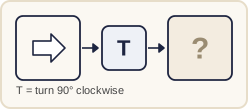
The shape on the left passes through the operator. Which tile is the output?
About this test
Diagrammatic reasoning tests show shapes flowing through a process — each operator transforms the shape in a fixed way (turning it, shading it, resizing it or changing it) — and ask you to predict the output, deduce what an operator does, or find a missing step. They measure logical, rule-based thinking and are widely used to select for IT, engineering and graduate roles.
This free test mirrors that format: 24 timed puzzles across four areas. Each operator does exactly one thing, so the puzzles reward careful, step-by-step logic rather than guesswork. We score every section and email you a breakdown with your percentile, so you can see where you're strong and where practice helps most.
Frequently asked questions
What is a diagrammatic reasoning test?
It presents a flow of shapes through operators — boxes that each transform the shape in a fixed way — and asks you to work out the output, infer what an operator does, or find a missing operator. It measures logical, rule-based reasoning rather than knowledge.
Who uses diagrammatic reasoning tests?
They're common in graduate and professional selection — especially IT and software, engineering, and analyst roles. Publishers like SHL and Kenexa use this 'operators and flowcharts' format.
How is it different from abstract reasoning?
Abstract reasoning is about spotting a pattern in a set of figures. Diagrammatic reasoning is about applying defined process rules — following inputs through operators to an output — so it's closer to logical flow and rule application.
How is the test scored?
One mark per correct answer across four sections — Single Operators, Operator Chains, Inferring Rules, and Missing Steps. We email a section-by-section breakdown and your percentile so you can see how you compare and where to focus.
How can I improve at diagrammatic reasoning?
Track one attribute at a time (orientation, shade, size, shape) as the shape moves through each operator, and write down the state after every step. Practising chains and missing-step puzzles builds speed and accuracy.