Classic Series · Full-Length Edition
IQ Battery — The Classic 40
The full-length classic battery, in the format Hans Eysenck's self-scoring IQ books made famous: forty original puzzles — word bridges, anagrams, double-duty words, letter and number series, rule-linked wheels and grids, and figure sequences — interleaved under the classic 30-minute clock. Exam conditions: no feedback until you finish, then a full results report with a classic-style scale estimate for your score, plus a worked solution for every item naming the exact rule. Squizly is not affiliated with the estate of H.J. Eysenck or any psychometric test publisher, and this test is not endorsed by either; the historical name describes the format. Every puzzle here is an original item written in the classic mixed-battery style.
40 worked questions · full worked solutions
Free sample questions
1. Insert the letters that complete the first word and begin the second: CAR ( … ) IC
Solution. TON completes both: CARTON and TONIC. PET and GO complete only CARPET and CARGO; ATT begins ATTIC but CARATT is no word.
2. The number in brackets is made from the two outside numbers by one fixed rule: 8 (28) 6. Apply the same rule: 9 ( ? ) 6
Solution. The bracketed number is twice the sum of the outside pair: (8 + 6) × 2 = 28, so (9 + 6) × 2 = 30. Copying the demo's 28 is the trap.
3. The figures change by the same rule at every step. Which figure comes next?
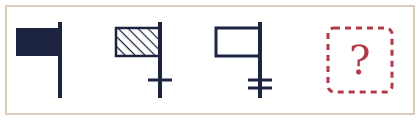


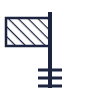
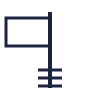
 ✓
✓
Solution. The fill advances solid → hatched → open and one base mark is added at every step. The fourth flag is solid again (the cycle closes) with three marks.
37 more in the full test
Every question comes with a full worked solution — the fastest method, not just the answer.
- Each option is a common English word with its letters scrambled. Three of the unscrambled words belong to the same category — which one does not?
- What number comes next? 45, 41, 36, 30, 23, ?
- Which letter comes next? Y U Q M ?
- Each row follows the same rule. Which tile completes the third row?
- The number in each roof circle is made from the window and door numbers by one fixed rule. What replaces the question mark?
- Which word can mean both “a flash of lightning” and “to run away suddenly”?
- Every row and every column contains each dial style and each hand position exactly once. Which clock completes the square?
- Each row of three numbers follows the same rule. What replaces the question mark? 6 4 8 9 2 16 7 5 ?
- Insert the letters that complete the first word and begin the second: IN ( … ) ATION
- What number comes next? 5, 8, 14, 26, 50, ?
- The top row changes left to right by one rule; the left column changes top to bottom by another. Which figure completes the square?
- Each option is a common English word with its letters scrambled. Three of the unscrambled words belong to the same category — which one does not?
- The six sectors of the wheel are linked by one fixed rule. What number replaces the question mark?
- Which letter comes next? C F D G E H ?
- Each row follows the same rule. Which tile completes the third row?
- Letters and numbers alternate, each following its own rule. What number comes next? A 2 D 8 G 32 J ?
- Which word can mean both “a steep bank or cliff” and “to mislead by pretending confidence”?
- The number in brackets is made from the two outside numbers by one fixed rule: 36 (14) 8. Apply the same rule: 52 ( ? ) 18
- The figures change by the same rule at every step. Which figure comes next?
- Each option is a common English word with its letters scrambled. Three of the unscrambled words belong to the same category — which one does not?
- The centre number of each triangle is made from its three corner numbers by one fixed rule. What replaces the question mark?
- Insert the letters that complete the first word and begin the second: MAS ( … ) MINAL
- Every row and every column contains each dial style and each hand position exactly once. Which clock completes the square?
- What number comes next? 16, 23, 28, 38, 49, ?
- The word in brackets is formed from the outer words by one fixed rule: CARGO (CASK) FLASK. Apply the same rule: BEACH ( ? ) FOREST
- The top row changes left to right by one rule; the left column changes top to bottom by another. Which figure completes the square?
- The figures change by the same rule at every step. Which figure comes next?
- The letters of an eight-letter English word run around the circle in order (you must find where it starts and which way it reads). Which two letters are missing?
- The six sectors of the wheel are linked by one fixed rule. What number replaces the question mark?
- Which word can mean both “a marked-out playing field” and “how high or low a sound is”?
- Each row follows the same rule. Which tile completes the third row?
- Insert the letters that complete the first word and begin the second: OVER ( … ) WAY
- The number in brackets is made from the two outside numbers by one fixed rule: 9 (26) 22. Apply the same rule: 14 ( ? ) 31
- Each option is a common English word with its letters scrambled. Three of the unscrambled words belong to the same category — which one does not?
- The top row changes left to right by one rule; the left column changes top to bottom by another. Which tile completes the square?
- What number comes next? 2, 9, 6, 13, 10, 17, ?
- The word in brackets is formed from the outer words by one fixed rule: SOFA (FACE) CELLAR. Apply the same rule: PIANO ( ? ) SEVEN
Your score, read against a curve
Finish the 40 items and your raw score becomes a classic-scale estimate on the familiar scale — like this sample:
An estimate anchored to this test's design difficulty, on the familiar classic scale (mean 100, SD 15). Most informative between 85 and 125; treat scores outside that range as indicative only. It is not a clinical measurement.